Naming |
| Botanical Name: |
Arctium lappa
|
| Common Names: |
great burdock; Bardana; 4); Bardane; Burdock (2; Burdock root; Beggars's buttons; Burrburr; Burrseed; Clothburr; Cocklebur; Cockle-Button; Cockold-dock; fox's clote; Grass burdock; hardock. harebur (2 4; 5); Hill; Hurrbur; Lappa; Lappa minor; Lappa Tousntosa; Niu-ts'ai; Niu-p'ang-tzu; Pien-ch'ien-niu; P'ang-ch'ien-niu; Pien-futz\'u; Shu-nien; Stick-buttons; Ta-li-tzu; Thorny Burr; turkey burr; Wu-shish; Ye-ch\'a-t\'cu; Burdock; Pien-futz'u; Ye-ch'a-t'cu
|
| Key Name: |
arctium_lappa
|
| Parts Used: |
|
| Sister Plants: |
|
| Comments: |
Lappa NOTES:
|
Taxonomy |
| Kingdom |
Viridiplantae |
Phylum |
Streptophyta |
| Class |
Magnoliopsida |
Order |
Asterales |
| Family |
Asteraceae |
Genus |
Arctium |
| Species |
lappa |
NCBI Tax ID |
4217
|
| Organism |
Arctium lappa
|
|
Characteristics |
| Identifying Character: |
Biennial Asteraceae; STEM: 1st year none, 2nd year 2-7ft stout with wide-spreading branches, coarse Leaves: alternate elongated; (coardate-oblong and rhubarb-like), heart-shaped Leaves, large and wavy, Rough, fleshy, dentate, peiolate, whitish beneath. flowers: purple, globular heads with a calyx of imbricated scale (burs or brackets) with hooked extremities for adhering lightly to objects. Bloom in July and August, ROOT: Nearly simple, fusiform or spindle-shaped, 1/5 - 4/5 " thick, 10-30 " long, brownish-gray externally Longitudinally wrinkled, annulate crown (often with a woolly tuft of leaf remains). somewhat horny fracture, dark cambium separates the thick outer Bark from the yellowish or white porous, and radiate wood, hollow centre or contains white plit-like tissue inside. powder: light brown. FRUIT: Achine, globoidal, 1/2- 1" broad, Imbricated scale with hooked extremities that adhere to anything, The red is obovate-oblong, angular, slightly curved, one-forth inch long brownish-gray to black wrinkled seed. One plant may produce 400,000(7). TASTE: root and seed Mulsilaginous, sweetish, slimy taste slightly Bitter. leaf and stem Bitter. ODOUR: Slight
|
| Stem: |
|
| Leaves: |
|
| Flowers: |
|
| Fruit: |
|
| Taste: |
|
| Odour: |
|
| Root: |
|
| Image: |
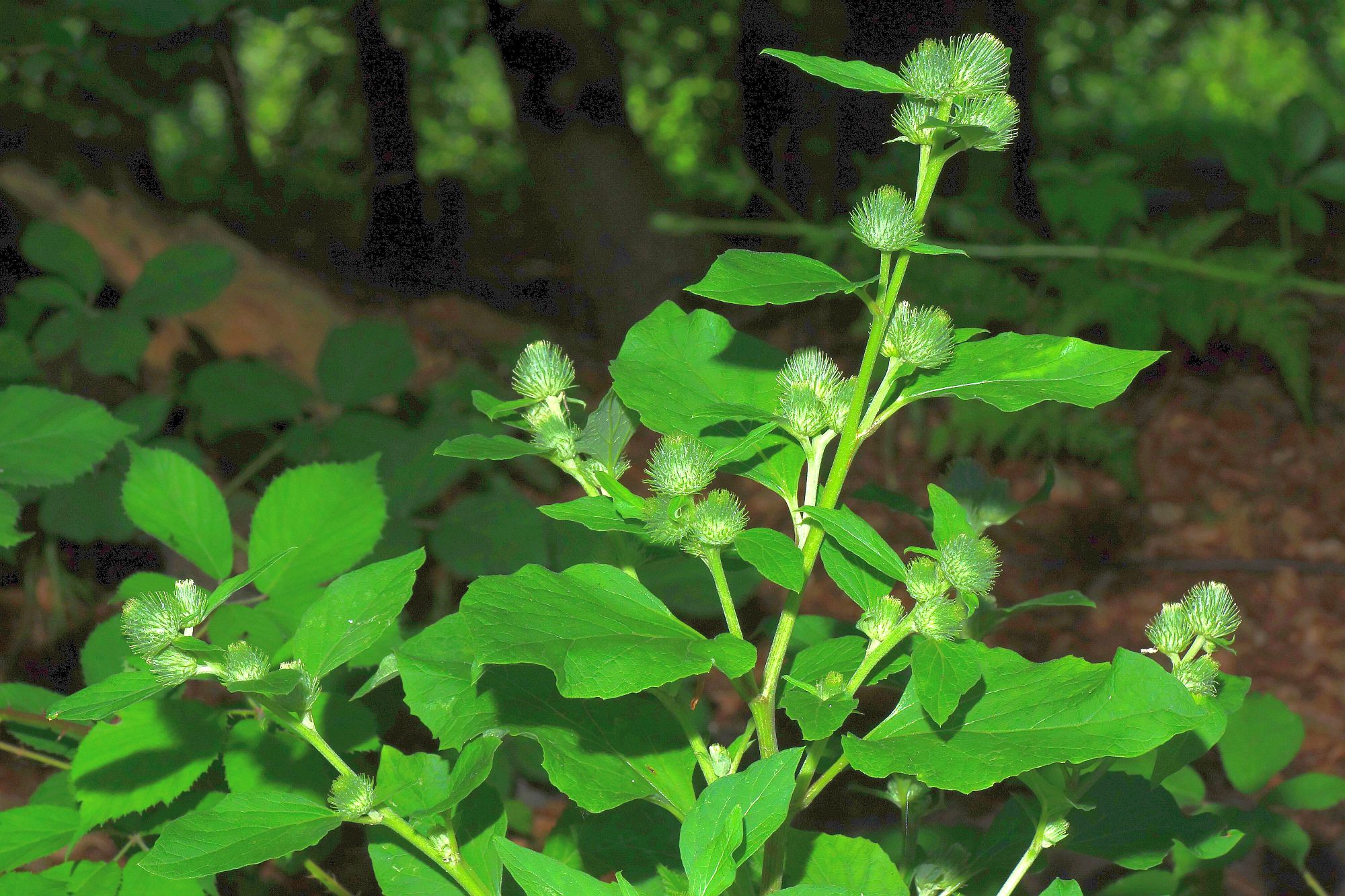
GBIF — CC BY-NC-ND

GBIF — CC BY-NC-ND
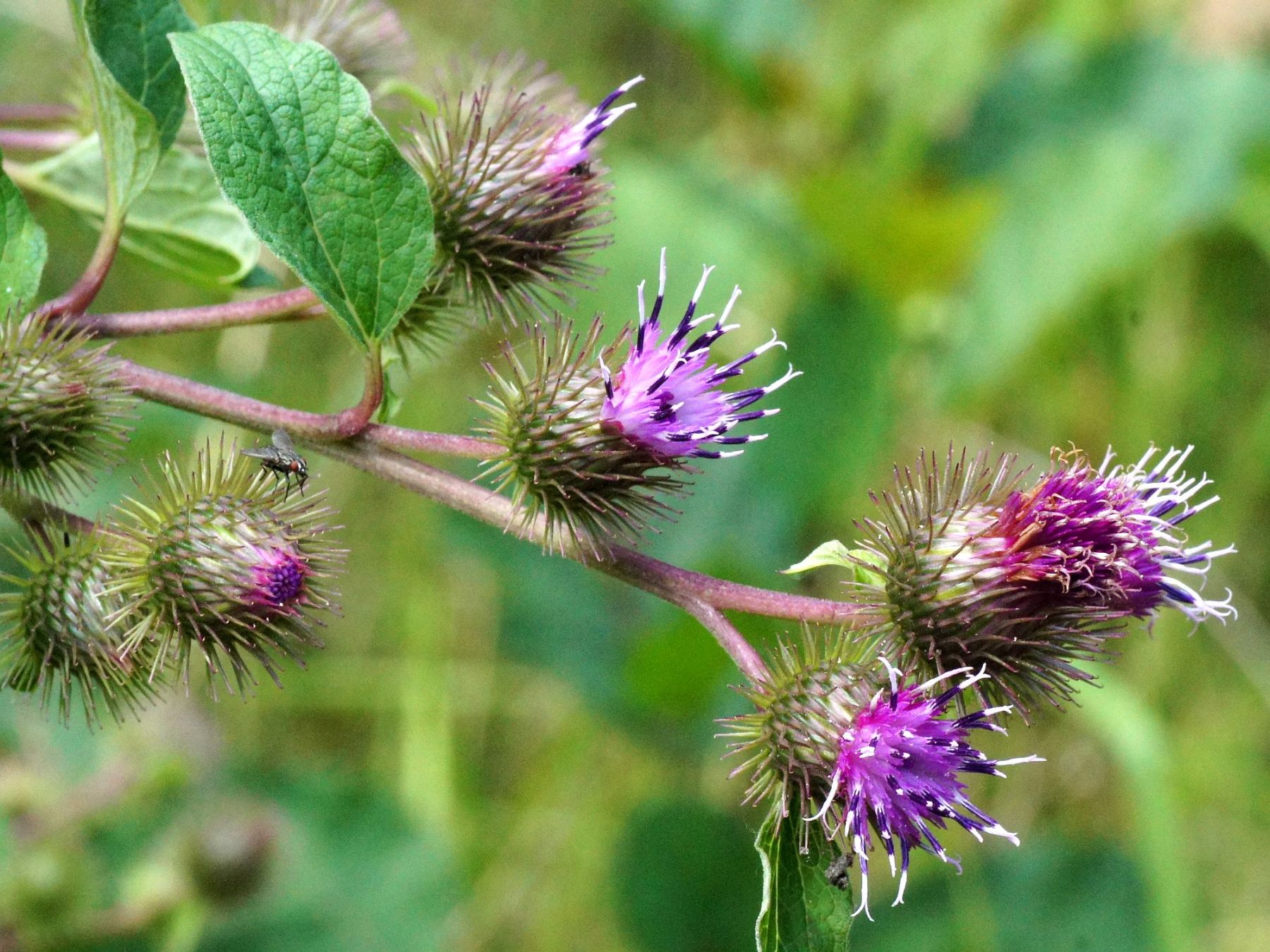
GBIF — CC BY-NC-ND

Arctium lappa
Wikipedia — Wikimedia
GBIF — CC BY-NC-ND
GBIF — CC BY-NC-ND
GBIF — CC BY-NC-ND
Arctium lappa
Wikipedia — Wikimedia
GBIF — CC BY-NC-ND
GBIF — CC BY-NC-ND
GBIF — CC BY-NC-ND
|
Distribution |
| Distribution: |
Naturalized in North America, from Asia and Europe, along roadsides and in all vacant lots.
|
| Cultivation: |
|
| Harvest: |
Root: Root of first year plant is harvested in fall or early spring Wash root in agitator or tumble washer, If the soil has lots of clay don't change the water Dry roots partially then chip, We have used an impact chipper for this with good results. The semidry roots don't powder as easily this reduces loss through dust and increases the operator safety. The rootchips are then dried the rest of the way.
|
Medical |
| Therapeutic Action: |
Alterative ( 3, 5, 46), Aperient (2, 5), Astringent, Antiscorbutic ( 5), Cholagogue (2), Depurative ( 5, 46), Diaphoretic ( 2, 3, 5, 46), Diaphoretic ( 2, 3, 5, 46), Emollients, Laxative ( 4), Stomatic ( 4, 5), Tonic,;
|
| Medical Uses: |
It is one of the best Alterative and Depurative (blood-purifying) agents in nature but dose not nameeate,. Burdock root beneficially influences the skin, soothes the kidneys and relieves congestions of the Lymphatic's, It increases the flow of urine and it is a useful agent for removing excess and fatty (adipose) tissue. Leaves Skin wash, poultices, Wounds, Bruises, sprains, irritation. Astringent Blood purifier. ( 3, 5), Boils. (3, 5) , Burns ( 3, 5), Canker sores ( 3, 5), Catarrh ( 5), Colds. ( 5), Eczema. ( 5), Eruptions ( 5), Fevers ( 5), Gonorrhea ( 3, 5), Gout ( 5), Haemorrhoids ( 5), Itch. ( 5), Bladder troubles">Kidney and Bladder troubles ( 3, 5), Poison Oak and Ivy rashes (2), Pimples ( 5), Psoriasis ( 5), Pulmonary affections ( 5), rashes ( 5), Rheumatism. ( 3, 5), Ringworm (5), Sciatica. (3), Scrofula (3, 5), Scurvy (, 5), Skin troubles (3, 5), Swellings (3, 5), Syphilis (3, 5), Urinary deposits (, 5), Wounds (3, 5) Seed oily Deusratsart,; poultice for skin problems, for removing poisons. Diuretic, Laxative Root internal (contains, 27 to 45%% inulin) Diabetes, Rheumatism. , kidney, lymph, Cancer. (Tincture of Seed) Kidney (seed), Wash for acne. ( 5), hives, Boils. ( 5), dandruff, Psoriasis ( 5) effective in fighting bacteria & fungi, lower blood sugar levels.
|
| Constituents: |
|
| Solvents: |
|
| Dosage: |
|
| Administration: |
|
| Formulas: |
|
| Contraindications: |
|
| Preparation: |
Decoction (roots), fluid extract, infusion (Leaves), powder, Solid extract, Tincture,
|
| Chinese: |
|
| Veterinary: |
Saus as humans
|
| Homeopathic: |
Tincture of fresh root- acne. , Buniion, Dupuytre's contraction, Eczema. serpegionsa, Eruptions, Glands(affections of), Gonorrhea, Gout, Impotence, Leucorrhoea, Posphaturia, Rheumatism. , Ringworm, Scrofula, Sterility, Ulcers, Uterus (Prolapse of).
|
Pollination and Pollinators |
| Apis: |
No
|
| Pollinator: |
|
| Pollen: |
No
|
| Pollen Notes: |
|
| Nectar: |
No
|
| Nectar Notes: |
|
Other |
| Non-Medical Uses: |
|
| Culinary Uses: |
|
| History: |
|
| Reference: |
The Herb Book 140-41, 459, 460, 500, 506, 573 Indian Herbalogy of North America. 25, 62, 75, 159, 234, 242, 253, 262, 265, 275, 284, 302; Modern Encyclopedia of herbs. 79 School of Natural Healing. 64, 273 Ginseng and other Medicinal Plants. 324(ill) Chinese Medicinal Herbs. 45 Herbal Handbook for Farm and Stable 45
|
| URL: |
/ENCY/legacy/usbmarl.htm
|
| Share: |
Private
|